How to Hang a Canvas Without Nails
A canvas is the easiest thing on your wall to hang damage-free and the easiest to get wrong, because the only solid part of its back is a frame of timber around the edge.
By Janet H. · Published

Put the adhesive strips on the wooden stretcher bars, not on the canvas back. The middle of a canvas back is a hollow void with nothing but fabric across it, and a strip stuck there is holding fabric to a wall.
Weight is almost never the constraint. A stretched canvas has no glazing and no backing board, so a 24x36 canvas weighs less than an 11x14 framed print with real glass. The constraint is where there is something solid to stick to.
Disclosure: Hang & Hue earns commission from qualifying purchases made through the links on this page, at no extra cost to you. As an Amazon Associate we earn from qualifying purchases. It does not change which products we recommend or the order they appear in — read our editorial policy and full affiliate disclosure.
Quick picks
Tap any row to jump to the full write-up.
| # | Product | Best for | Price |
|---|---|---|---|
| 1 | 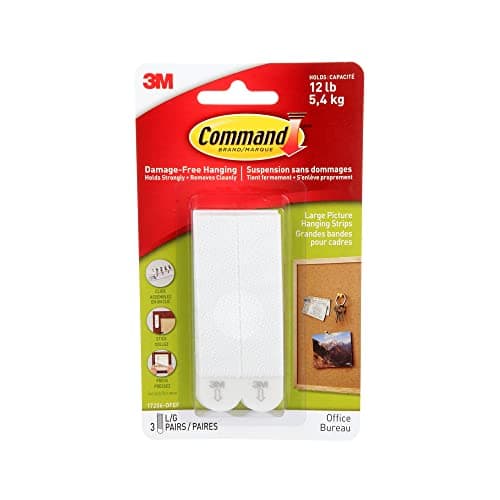 Command Large Picture Hanging Strips (17206) 4 lb per pair on the stretcher bars is comfortably more than a canvas of almost any size needs, and the flat timber bar is the ideal substrate for a strip. | Best overall | $9.99 · View on Amazon #ad How we’re funded · Price as of November 1, 2026 |
| 2 | 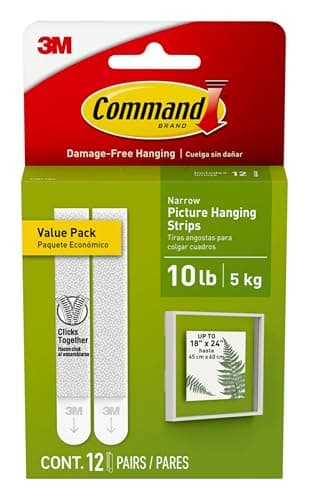 Command Narrow Picture Hanging Strips (17207) 3 lb per pair in a narrow format that fits a 0.75 inch stretcher bar without overhanging into the hollow middle - which is the specific failure on a slim canvas. | Best for slim canvases | |
| 3 | 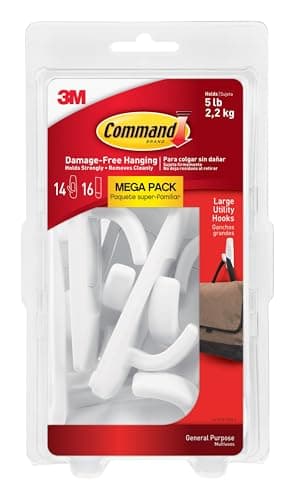 Command Large Wall Hook (17003) If the canvas arrived with a wire or a raised sawtooth, a rated hook is the right answer - the canvas hangs free and can be leveled by hand afterwards. | Best when there is a wire or sawtooth | $29.22 · View on Amazon #ad How we’re funded · Price as of November 1, 2026 |
| 4 | 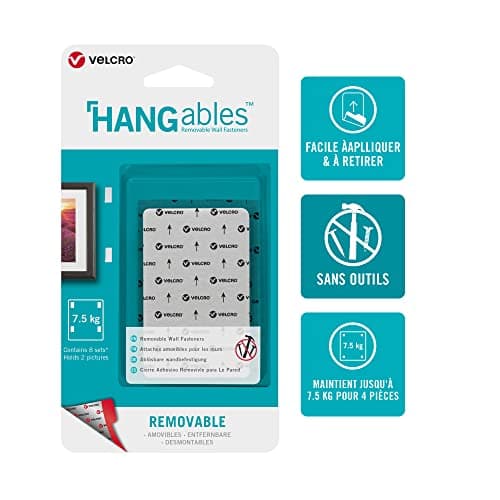 VELCRO Brand HANGables Removable Wall Fasteners Hook-and-loop lets the canvas lift off the wall pad and go back without re-applying anything, which suits a wall you expect to change. | Best for rearranging | $8.99 · View on Amazon #ad How we’re funded · Price as of November 1, 2026 |
What is actually behind a canvas
Turn a stretched canvas over and you see the structure, which is why this is a different job from hanging a frame.
- A timber stretcher frame around the perimeter, usually 0.75 to 1.5 inches deep and about 1.5 inches wide. This is the only rigid part.
- A hollow middle with nothing across it but the back of the fabric. Pressing here flexes the canvas and can leave a permanent dent in the front.
- Sometimes a cross brace on larger canvases, running corner to corner or across the middle. Solid, and useful.
- Often no hanging hardware at all. Many canvases ship with a sawtooth, some with a wire, and plenty with nothing.
The strip method, step by step
- Weigh it. Thirty seconds on a kitchen scale. Canvases are light, but the number decides how many pairs you need.
- Lay it face down on a towel and find the stretcher bars by feel. Mark the inside edge of the top bar with a pencil if it helps.
- Place a pair of strips on the top bar, one near each corner, with the strips running vertically. On anything over 18 inches wide, add a second pair on the bottom bar so the canvas cannot pivot away from the wall at the base.
- Press each one for 30 seconds against the bar, supporting the bar from the other side with your other hand. Never press against unsupported fabric.
- Mount, remove, press the wall side, wait an hour. The published method, and the hour is the step people skip.
The published ratings give the per-pair and per-frame figures, and the strip roundup compares the sizes.
When the canvas has no hanging hardware
This is the common complaint, and it is actually good news for damage-free hanging: a bare stretcher back is exactly what adhesive strips want. A sawtooth or a wire is what forces you into a hook.
| What the back has | Best no-drill method | Why |
|---|---|---|
| Nothing at all | Adhesive strips on the stretcher bars | A flat rigid timber surface is the ideal strip substrate |
| A raised sawtooth hanger | An adhesive hook, or remove the sawtooth | A raised sawtooth holds the canvas off the wall and strips cannot make contact |
| A wire across the back | An adhesive hook | The wire is already the right fitting for a hook; leave it alone |
| Keyhole slots routed into the bars | An adhesive hook with a low profile | The slot is designed to drop over a fixing head |
| A cross brace only | Strips on the perimeter bars, hook on the brace | Both are solid; the perimeter gives better leveling |
Hooks versus strips covers which to reach for, and the hook roundup lists the published ratings.
Why canvas is the renter's format
If you are choosing what to put on the wall rather than hanging something you already own, this is the case for canvas over a framed print.
| Stretched canvas | Framed print | |
|---|---|---|
| Glazing weight | None | Glass or acrylic over the full area |
| Backing board | None | MDF or card |
| Weight at 24x36 | Light enough for one or two pairs of strips | Near or past the adhesive ceiling |
| Arrives ready to hang | Usually | Usually, with hardware fitted |
| Protects the artwork | No - the surface is exposed | Yes |
| Bathroom and kitchen | Poor - fabric holds moisture and grease | Better, with acrylic glazing |
| Looks like | Art object; no border | Finished and formal |
Canvas versus framed print is the full comparison, and the canvas roundup covers the picks.
If adhesive is not an option at all
On cinder block, painted brick, bare plaster or in a residence that bans adhesive products, there are still three routes that leave the wall alone.
- Lean it on a ledge. A canvas has a flat bottom edge and no glass to slide, so it leans more stably than a frame does. Two fixings for the ledge, and then you can rearrange forever — picture ledges.
- Mortar-joint clips on brick or block, which carry real weight with no adhesive and no hole — the brick method.
- A picture rail, if you have several pieces. Two fixings carry the whole wall and canvases hang from cables — rail versus adhesive.
The picks in full
Each entry states what it is for, the specification that decides it, and who should skip it.
1. Best overall
Command Large Picture Hanging Strips (17206)
3M Command
4 lb per pair on the stretcher bars is comfortably more than a canvas of almost any size needs, and the flat timber bar is the ideal substrate for a strip.
- Rated weight
- 4 lb per set (pair)
- Max per frame
- 16 lb using four pairs
- Wall types
- Painted drywall, finished wood, tile, metal, glass
- Removal
- Stretch-release tab
The spec that decides it: 4 lb per pair, 16 lb maximum per piece with four pairs.
Skip it if: The stretcher bar is narrower than the strip, where a narrow strip fits better.
#ad How we’re funded · Price as of November 1, 2026
2. Best for slim canvases
Command Narrow Picture Hanging Strips (17207)
3M Command
3 lb per pair in a narrow format that fits a 0.75 inch stretcher bar without overhanging into the hollow middle - which is the specific failure on a slim canvas.
- Rated weight
- 3 lb per set (pair)
- Strip width
- Narrow — fits slim gallery-frame backs
- Wall types
- Painted drywall, finished wood, tile, metal, glass
- Removal
- Stretch-release tab
The spec that decides it: 3 lb per pair in a narrow strip width for slim frame backs.
Skip it if: The canvas is gallery depth, where a large strip sits on the bar comfortably.
3. Best when there is a wire or sawtooth
Command Large Wall Hook (17003)
3M Command
If the canvas arrived with a wire or a raised sawtooth, a rated hook is the right answer - the canvas hangs free and can be leveled by hand afterwards.
- Rated weight
- 5 lb
- Hook style
- Plastic, white
- Wall types
- Painted drywall, finished wood, tile, metal, glass
- Removal
- Stretch-release tab
The spec that decides it: Rated adhesive hook with a stretch-release tab, no drilling.
Skip it if: The back is bare timber, because strips hold it tighter to the wall and look better.
#ad How we’re funded · Price as of November 1, 2026
4. Best for rearranging
VELCRO Brand HANGables Removable Wall Fasteners
VELCRO Brand
Hook-and-loop lets the canvas lift off the wall pad and go back without re-applying anything, which suits a wall you expect to change.
- Rated weight
- Up to 16 lb per pack (manufacturer figure)
- Strip size
- 1.75 x 3 in
- Fastening
- Hook-and-loop — frame lifts off the wall pad
- Removal
- Peel tab on the wall-side pad
The spec that decides it: Hook-and-loop fastening, 1.75 x 3 in pads, peel tab on the wall side.
Skip it if: You want the canvas sitting perfectly flush, because the pads add a little standoff.
#ad How we’re funded · Price as of November 1, 2026
Common questions
How do you hang a canvas without nails?
With adhesive strips placed on the wooden stretcher bars around the perimeter of the back, never on the hollow middle. Weigh the canvas first, use one pair on the top bar and a second pair on the bottom bar for anything over 18 inches wide, and wait a full hour after pressing the wall side before loading it.
Can you use Command strips on a canvas?
Yes, and a canvas is one of the better candidates because it has no glazing and no backing board, so it weighs far less than a framed print of the same size. The requirement is that the strips sit on the timber stretcher bars, which are the only rigid part of the back.
How do you hang a canvas with no hardware on the back?
A bare stretcher back is the easiest case, not the hardest - a flat rigid timber surface is exactly what adhesive strips want. Place a pair on the top bar near each corner and a second pair on the bottom bar if it is wide. Hardware such as a raised sawtooth is what forces you into using a hook instead.
Why should you not press on the middle of a canvas?
The middle of a stretched canvas is a hollow void with only fabric across it. Thumb pressure there pushes the weave out of shape and the dent does not always relax back out. Work face down on a towel and press only against the stretcher bars, supporting each bar from the other side.
Is a canvas lighter than a framed print?
Considerably. A canvas has no glazing and no backing board, which are the two heaviest parts of a framed picture. A 24x36 canvas typically weighs less than an 11x14 framed print with real glass, which is why canvas is the format that solves large walls in a rental.
Sources for the figures on this page
Read next
- How to Hang Pictures Without Nails
Every no-nail method ranked by rated weight capacity, from 1 lb poster strips to a 35 lb drywall hook.
- Canvas vs Framed Print
Weight, protection, durability by room, and which format a wall you cannot drill actually allows.
- Best Canvas Wall Art
What to check on a canvas listing, which rooms it suits, and the three specs that separate a good canvas from a bad one.
- How Much Weight Can Command Strips Hold?
Published per-pair and per-frame weight ratings for every strip size, the ceiling by frame size, and the three things that make a correctly rated strip fail anyway.
- Adhesive Hooks vs Adhesive Strips
Hooks versus strips on rated weight, whether the frame sits flush, whether you can straighten it afterwards, and what the frame back has to have.
- Best Picture Hanging Strips
Strip-by-strip weight ratings mapped to the frame sizes each one suits, from a 5x7 photo to a 24x36 poster frame.
- Best Picture Ledges
Ledges compared on length, lip depth and mounting — the two-screw alternative to hanging a whole gallery wall.
- Hanging Pictures on Plaster Walls
How to identify plaster, why it fails differently from drywall, and the adhesive and no-drill methods that work on sealed plaster - plus what to do with lath.