Gallery Wall Layouts and Spacing
Three numbers separate a gallery wall that looks deliberate from one that looks accidental. None of them is about taste.
By Janet H. · Published
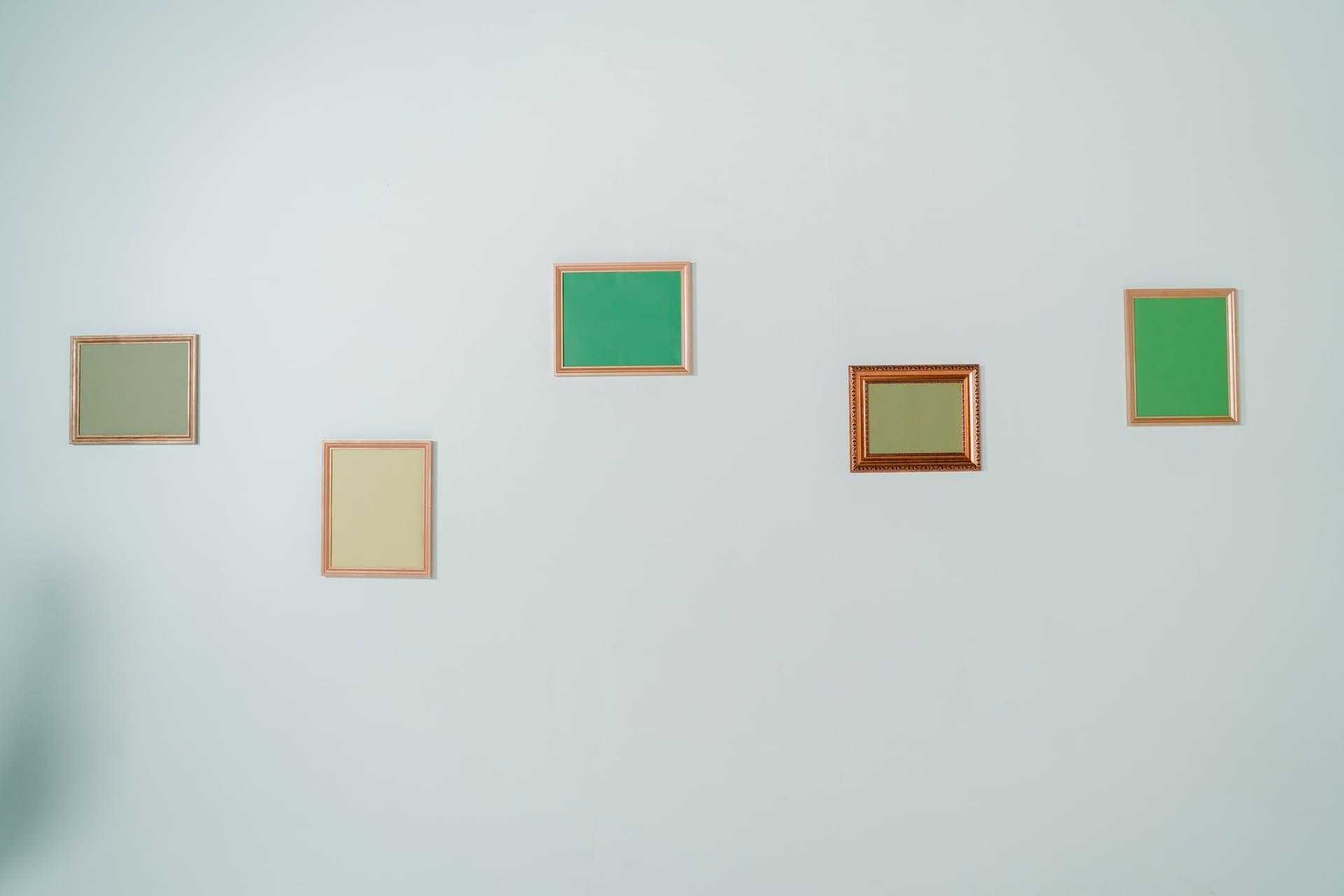
Leave 2 to 3 inches between every frame, center the whole arrangement 57 inches from the floor, and size it to two-thirds or three-quarters of the furniture below. Get those three right and almost any set of frames will read as intentional.
Uneven gaps are the only thing the eye reliably reads as a mistake — and it reads it instantly, even in people who could not tell you why.
Disclosure: Hang & Hue earns commission from qualifying purchases made through the links on this page, at no extra cost to you. As an Amazon Associate we earn from qualifying purchases. It does not change which products we recommend or the order they appear in — read our editorial policy and full affiliate disclosure.
Quick picks
Tap any row to jump to the full write-up.
| # | Product | Best for | Price |
|---|---|---|---|
| 1 |  Americanflat Gallery Wall Frame Set Mixed sizes designed to hang as one arrangement, so the width arithmetic is largely done for you before the box arrives. | Best starting point | |
| 2 | upsimples Gallery Wall Frame Set One size in a matched multi-pack, which is all a grid layout needs and the cheapest route to nine frames. | Best for a grid | |
| 3 |  Command Large Picture Hanging Strips (17206) Nine frames is eighteen nail holes otherwise. Rated 4 lb per set and 16 lb per frame, which covers almost every gallery frame. | Best way to hang it | |
| 4 | 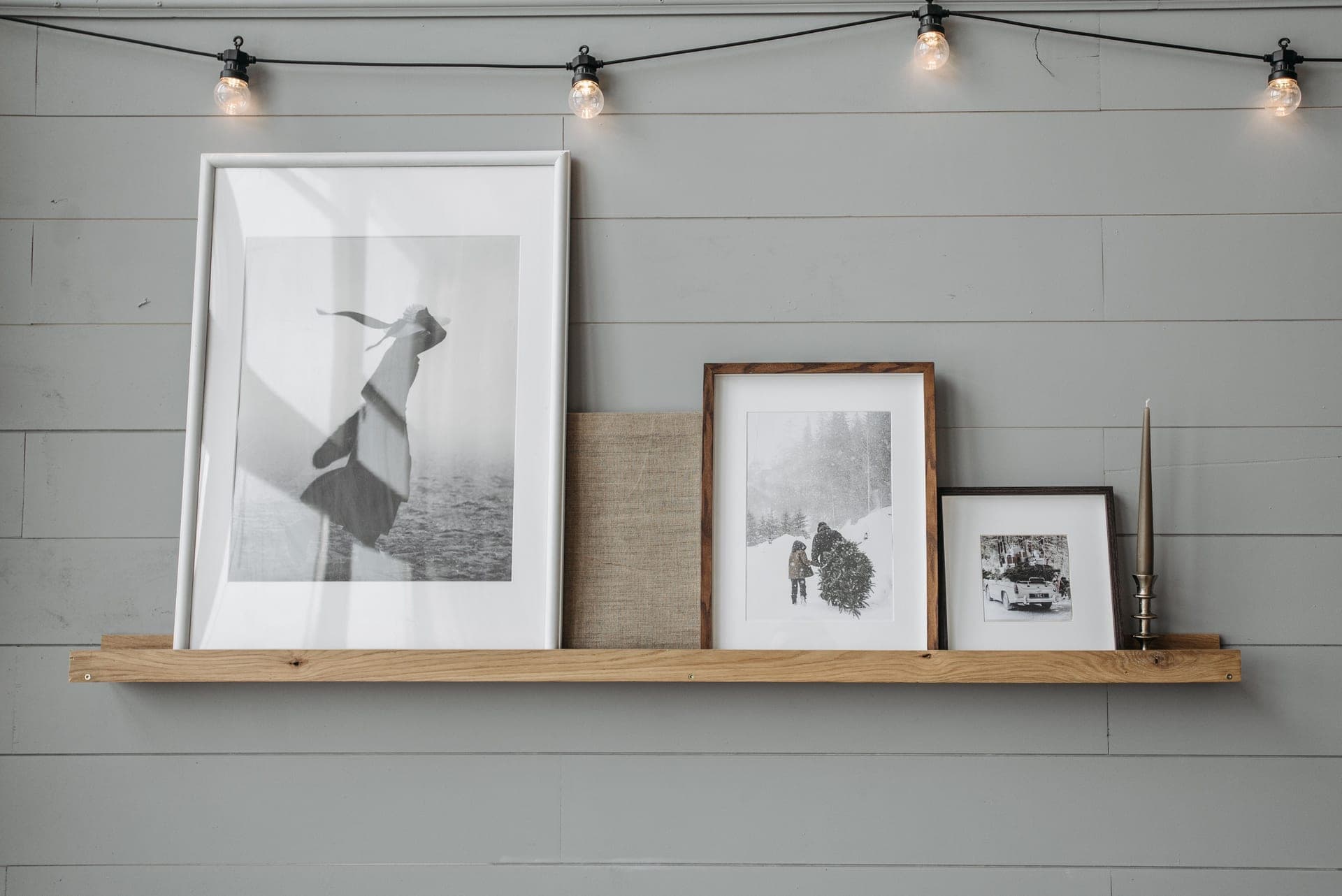 Kate and Laurel Levie Wood Floating Picture Ledge Two screws and the arrangement rearranges in seconds. Sidesteps the spacing problem entirely because the frames simply lean. | Best if the layout may change |
The gap: 2 to 3 inches, and identical everywhere
Consistent negative space is what makes several separate objects read as one. Vary it and the brain stops grouping them.
| Frame size | Gap | Why |
|---|---|---|
| 5x7 and 8x10 | 2 in | A 3 in gap around a small frame swallows it |
| 11x14 and 16x20 | 2.5-3 in | The working default for most gallery walls |
| 20x24 and larger | 3 in | Larger frames need the breathing room to stay distinct |
| Mixed sizes | 3 in on everything | The gap is the constant; the frames are the variable |
The height: 57 inches to the group center
The gallery standard applies to the arrangement as a whole. Individual frames sit above and below it; only the center of the group matters.
To find it:
- Lay the arrangement out on the floor and measure its total height.
- Halve that number.
- Add 57. That is where the top edge of the arrangement goes.
A 31 inch tall arrangement: half is 15.5, plus 57 puts the top edge at 72.5 inches and the bottom at 41.5. The height guide covers the hook arithmetic for individual frames.
Over furniture, clearance wins. Leave 6 to 8 inches between the sofa back or table top and the bottom frame edge, even if that puts the group center below 57. A gap much bigger than 8 inches makes the art float away from the furniture and stop belonging to it.
The width: two-thirds of the furniture
This is where most gallery walls go wrong, and it goes wrong before anything is hung — at the point the frames were bought.
| Furniture | Width | Target arrangement width | That looks like |
|---|---|---|---|
| Console | 48 in | 32-36 in | A 2x2 grid of 11x14, or three 8x10 |
| Loveseat | 58 in | 39-44 in | Three 11x14 in a row, or a 3x2 grid |
| Standard sofa | 84 in | 56-63 in | Three 16x20 in a row, plus a second row |
| Sectional | 108 in | 72-81 in | Seven salon-style, or a 3x3 grid of 16x20 |
| Queen headboard | 60 in | 40-45 in | Three 11x14, or a 2x2 of 16x20 |
| King headboard | 76 in | 50-57 in | Five with a center anchor |
Six layouts with all this arithmetic already done are on the to-scale templates page.
The process, in the order that works
- Measure the furniture. Multiply by 0.7. That is your target width.
- Lay the frames out on the floor at your chosen gap until the total matches. Take a photo.
- Cut paper rectangles to each frame’s outer size and mark its hanging point.
- Tape the paper to the wall in the arrangement. Measure the gaps; do not eyeball.
- Leave it up for an hour. Look at it from where you actually sit.
- Mark through each hanging point, take the paper down, hang.
For the no-nails version of the hanging step, see hanging a gallery wall without nails.
The four mistakes worth naming
- Too small for the wall. The most common error by a distance. Five 8x10 frames over an 84 inch sofa look like an accident.
- Hung too high. Center the group at 57, not at the vertical middle of the empty wall. Tall ceilings tempt people upward and it always reads wrong.
- Varying gaps. Covered above, and worth repeating because it is the one the eye catches first.
- No unifying element. Mixed frames, mixed mats, mixed subjects and mixed finishes all at once is not eclectic, it is unresolved. What has to stay constant.
The picks in full
Each entry states what it is for, the specification that decides it, and who should skip it.
1. Best starting point
Americanflat Gallery Wall Frame Set
Americanflat
Mixed sizes designed to hang as one arrangement, so the width arithmetic is largely done for you before the box arrives.
- Set shape
- Mixed-size sets designed to hang as one arrangement
- Glazing
- Shatter-resistant plexiglass
- Matting
- Mats included on most sizes in the set
- Included
- Hanging hardware and, on some sets, a layout template
The spec that decides it: Coordinated mixed sizes with shatter-resistant plexiglass and hardware included.
Skip it if: You already own frames — buy a mat set instead and unify what you have.
2. Best for a grid
upsimples Gallery Wall Frame Set
upsimples
One size in a matched multi-pack, which is all a grid layout needs and the cheapest route to nine frames.
- Set shape
- Matched multi-packs, usually one repeated size
- Glazing
- High-definition plexiglass
- Matting
- Mat included on most sizes
- Included
- Wall-mount hardware
The spec that decides it: Matched multi-packs with wall-mount hardware included.
Skip it if: You want the salon-style look — a grid set gives you no size variation to work with.
3. Best way to hang it
Command Large Picture Hanging Strips (17206)
3M Command
Nine frames is eighteen nail holes otherwise. Rated 4 lb per set and 16 lb per frame, which covers almost every gallery frame.
- Rated weight
- 4 lb per set (pair)
- Max per frame
- 16 lb using four pairs
- Wall types
- Painted drywall, finished wood, tile, metal, glass
- Removal
- Stretch-release tab
The spec that decides it: 4 lb per set, 16 lb per frame using four sets.
Skip it if: The wall is textured or papered — no adhesive is reliable there.
4. Best if the layout may change
Kate and Laurel Levie Wood Floating Picture Ledge
Kate and Laurel
Two screws and the arrangement rearranges in seconds. Sidesteps the spacing problem entirely because the frames simply lean.
- Lengths
- Sold in several lengths including 24 in and 42 in
- Lip
- Front lip holds leaning frames
- Finishes
- White, black, gold
- Mounting
- Wall screws — one shelf replaces a row of frame holes
The spec that decides it: Front lip sized for leaning frames; lengths from 24 in up.
Skip it if: You want frames at multiple heights — a ledge puts everything on one line.
Common questions
How far apart should gallery wall frames be?
Two to three inches, and identical on every gap. Use 2 inches for frames 8x10 and smaller, 3 inches for 11x14 and larger. On a mixed-size wall, keep one gap throughout rather than scaling it with the frame.
How do you arrange a gallery wall?
Work out the target width first — two-thirds to three-quarters of the furniture below. Lay the frames on the floor until the total matches, cut paper templates, tape them to the wall at the planned gaps, and adjust on paper before anything is hung.
How high should a gallery wall be hung?
Center the whole arrangement 57 inches from the floor, not any single frame. Over furniture, clearance wins instead: leave 6 to 8 inches between the furniture top and the bottom frame edge.
How do you hang a gallery wall straight?
Hang the anchor frame first and work outward from it, measuring each gap rather than eyeballing. Starting from a corner accumulates every small error into the last frame, which is where the spacing visibly fails.
How wide should a gallery wall be above a sofa?
Two-thirds to three-quarters of the sofa width, including the gaps between frames. An 84 inch sofa wants roughly 56 to 63 inches of arrangement. Undersized art above a large sofa is the most common sizing error there is.
Sources for the figures on this page
Read next
- Gallery Wall Templates
To-scale layouts for 3, 5, 6, 7 and 9 frames with all dimensions labeled — the page no competitor publishes.
- Matching vs Mixed Frames
The four variables on a gallery wall, how many you can change at once, and why mixed walls usually fail.
- Hanging a Gallery Wall Without Nails
Strip ratings per frame size, the anchor-outward hanging order, and the curing step everybody skips.
- How High to Hang Art
The 57-inch gallery standard, the hook-position arithmetic, and the exceptions for sofas, beds, dining rooms and stairs.
- Frame Sizes for Gallery Walls
Frame size combinations by target wall width, with gaps included — the arithmetic to do before ordering.
- What Size Art Above a Couch
The two-thirds rule with a full sizing table by sofa width, and the 6-8 inch clearance that beats the 57 inch standard.