Best Picture Ledges
Two screws instead of twenty, and the layout changes whenever you feel like it. For a rented wall this is frequently the right answer.
By Janet H. · Published

Buy the longest ledge your wall takes, and check the lip is deep enough to hold a frame at an angle. Length is what makes a ledge read as a designed feature rather than a shelf, and the lip is the only thing stopping the frames sliding off.
A ledge is the one solution on this site that gets better the more you change your mind — which is exactly the situation most renters are in.
Disclosure: Hang & Hue earns commission from qualifying purchases made through the links on this page, at no extra cost to you. As an Amazon Associate we earn from qualifying purchases. It does not change which products we recommend or the order they appear in — read our editorial policy and full affiliate disclosure.
How these picks were chosen
We select on published specification — rated weight capacity, frame size compatibility, mounting method and materials — plus the durability patterns owners report at volume. We do not test these products ourselves. Read our full method.
Photographs on this page are licensed category images, not photographs of the individual products. Each link opens the product’s live listing, where the current photos, sizes and price are shown.
Quick picks
Tap any row to jump to the full write-up.
| # | Product | Best for | Price |
|---|---|---|---|
| 1 | 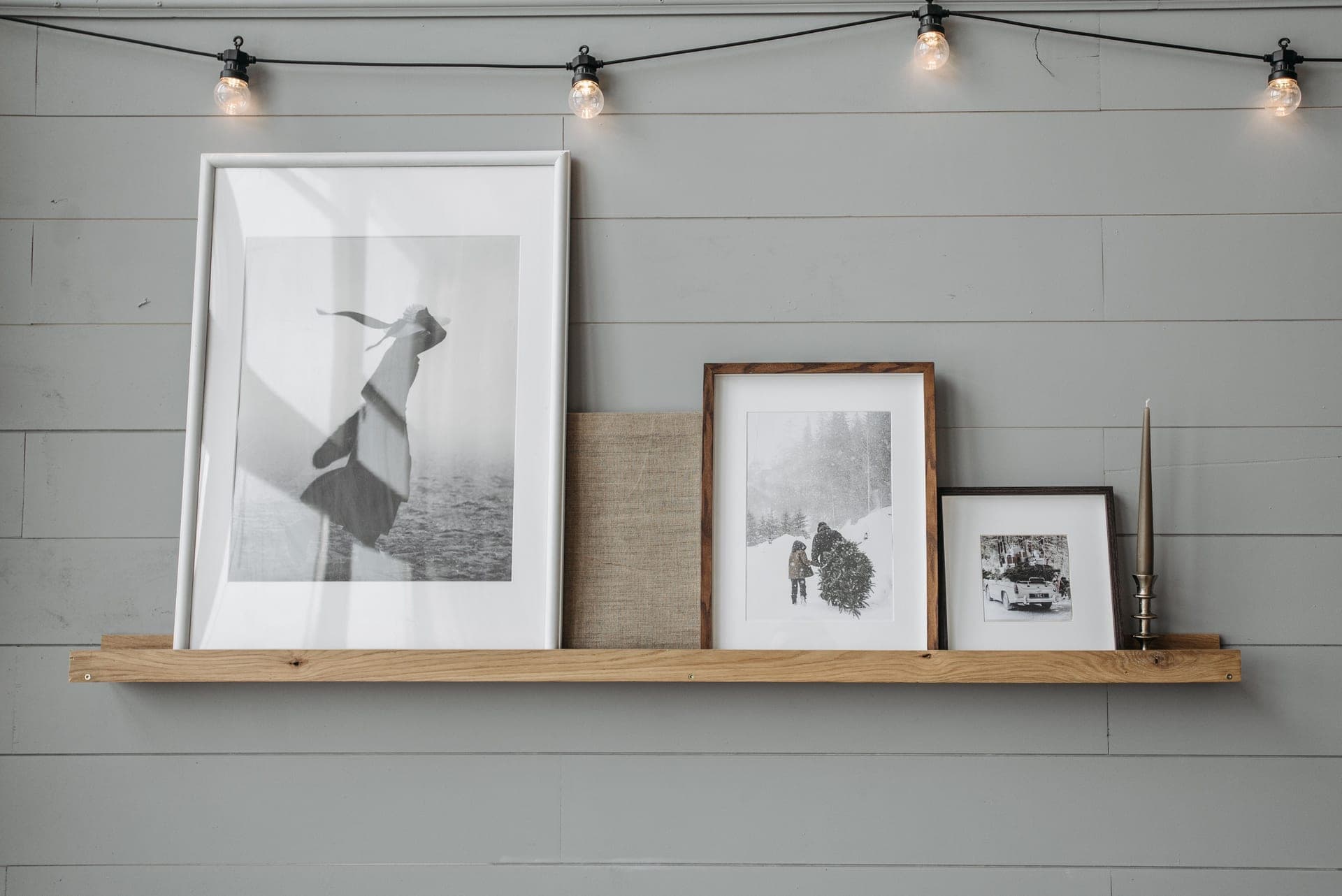 Kate and Laurel Levie Wood Floating Picture Ledge Sold in several lengths including 24 and 42 inches, in white, black and gold, with a lip sized for leaning frames. The one to buy for a living room wall. | Best overall | |
| 2 | Wallniture Denver Narrow Picture Ledge Shelf Metal, narrow, and available in long runs including 48 inches sold in pairs — which is how you get a two-row display in one order. | Best long run | |
| 3 | MCS Picture Ledge Shelf Plain woodgrain in 23.75 and 35 inch lengths, singly and in pairs. The cheapest way to get a whole wall off adhesive. | Best budget |
Why a ledge beats hanging, for a renter
| Hanging nine frames | One picture ledge | |
|---|---|---|
| Fixings in the wall | Up to 18 nail holes, or 36 adhesive strips | 2 screws |
| Changing the layout | New holes or new strips every time | Move the frames. Seconds. |
| Works on a textured wall | No | Yes |
| Works on wallpaper | No | Yes |
| Weight per frame | Capped by the strip rating | Only capped by the ledge fixing |
| Adding a frame later | New fixings, replanned spacing | Slide the others along |
| Overlapping frames | Not possible | Yes — and it looks deliberate |
What to check
- Length. Two-thirds to three-quarters of the furniture below, same as any wall arrangement. A short ledge on a long wall looks like a shelf somebody forgot to finish.
- Lip depth. The front lip is what stops a frame sliding forward. Shallow lips hold thin frames only; deeper lips take a chunky molding leaning back properly.
- Shelf depth. Narrow is better. A deep shelf invites clutter and stops reading as an art display.
- Mounting. Check whether the screws land where your studs are, or whether the supplied anchors suit drywall. This is the one place on the site where a wall anchor is genuinely the right call.
Making it look deliberate
A ledge is easy to hang and easy to style badly. Four rules:
- Layer. A larger frame behind, a smaller one overlapping in front. Layering is the whole point — a single row of evenly spaced frames on a ledge is just a badly hung gallery wall.
- Lean, do not stand. Frames tipped back against the wall read as casual and are far more stable than upright.
- Vary heights. Mixed frame sizes are an advantage here, not a problem to solve.
- Leave one end lighter. An arrangement weighted slightly to one side reads as styled; perfectly symmetrical reads as a shop display.
Two ledges stacked 16 to 20 inches apart give you a two-row display with four screws total, which is a genuine gallery wall for a fraction of the fixings.
Where a ledge is the wrong answer
- You want frames at different heights. A ledge puts everything on one line. That is its constraint and it does not bend.
- One large statement piece. A single 40x30 canvas belongs on the wall, not leaning on a shelf. Hanging kits.
- Absolutely no fixings allowed. A ledge is still two screws. In a dorm, adhesive or nothing. Dorm room wall art.
- Small children in the room. Leaning frames on an open ledge at child height come down easily.
The picks in full
Each entry states what it is for, the specification that decides it, and who should skip it.
1. Best overall
Kate and Laurel Levie Wood Floating Picture Ledge
Kate and Laurel
Sold in several lengths including 24 and 42 inches, in white, black and gold, with a lip sized for leaning frames. The one to buy for a living room wall.
- Lengths
- Sold in several lengths including 24 in and 42 in
- Lip
- Front lip holds leaning frames
- Finishes
- White, black, gold
- Mounting
- Wall screws — one shelf replaces a row of frame holes
The spec that decides it: Multiple lengths up to 42 in, with a front lip for leaning frames.
Skip it if: You need a run longer than about 42 inches — look at the metal ledges instead.
2. Best long run
Wallniture Denver Narrow Picture Ledge Shelf
Wallniture
Metal, narrow, and available in long runs including 48 inches sold in pairs — which is how you get a two-row display in one order.
- Lengths
- Long runs including 48 in, sold in sets of two
- Depth
- Narrow — designed for leaning frames, not storage
- Material
- Metal
- Mounting
- Wall screws
The spec that decides it: Long lengths including 48 in, sold in sets of two, narrow enough to stay an art display.
Skip it if: You want the warmth of wood — this is deliberately an industrial-looking product.
3. Best budget
MCS Picture Ledge Shelf
MCS Industries
Plain woodgrain in 23.75 and 35 inch lengths, singly and in pairs. The cheapest way to get a whole wall off adhesive.
- Lengths
- 23.75 in and 35 in, sold singly and in pairs
- Lip
- Front lip holds leaning frames
- Finishes
- White and black woodgrain
- Mounting
- Wall screws
The spec that decides it: 23.75 in and 35 in lengths with a front lip, in white and black woodgrain.
Skip it if: The wall is wide — two short ledges butted together always shows the join.
Common questions
Are picture ledges better than hanging frames?
For a rented wall, often yes. A ledge is two screws instead of up to eighteen nail holes, it works on textured and papered walls where adhesive does not, and the arrangement can be changed in seconds. The trade-off is that every frame sits on one line.
How deep should a picture ledge be?
Narrow — just deep enough for the frames to lean. A deep shelf collects clutter and stops reading as an art display. What matters more is the front lip, which is the only thing stopping a frame sliding forward.
How long should a picture ledge be?
Two-thirds to three-quarters of the furniture below it, the same rule as any wall arrangement. Over an 84 inch sofa that is roughly 56 to 63 inches, which usually means a long ledge or two shorter ones stacked.
How do you style a picture ledge?
Layer it. A larger frame behind with a smaller one overlapping in front, all leaning back against the wall, with heights varied and the arrangement weighted slightly to one side. A single row of evenly spaced frames is just a badly hung gallery wall.
Can you put a picture ledge on a textured wall?
Yes. The ledge is screwed through the surface into the wall behind it, so orange peel, knockdown and wallpaper make no difference — which is exactly why it is the standard recommendation for walls that defeat adhesive.
Sources for the figures on this page
Read next
- Hanging on Textured Walls
Why adhesive fails on orange peel, knockdown and popcorn — and the three fixings that hold on a textured wall.
- Gallery Wall Layouts and Spacing
The 2-3 inch gap rule, the 57 inch group center, and how to size the whole arrangement to the furniture below it.
- Small Apartment Gallery Walls
Vertical layouts, tighter spacing, which wall to use, and why one big piece sometimes beats nine small ones.
- Picture Rail vs Adhesive Hanging
Weight ceilings, install cost and what happens the third time you rearrange the wall.
- Wall Art for Small Apartments
Why fewer and larger wins, which walls to use, and formats light enough to hang with no holes.
- Hanging a Gallery Wall Without Nails
Strip ratings per frame size, the anchor-outward hanging order, and the curing step everybody skips.