How Many Frames for a Gallery Wall?
Measure the wall, take two thirds of it, and divide by the frame size you want. The number that falls out is your frame count — and it is usually smaller than you expected.
By Janet H. · Published
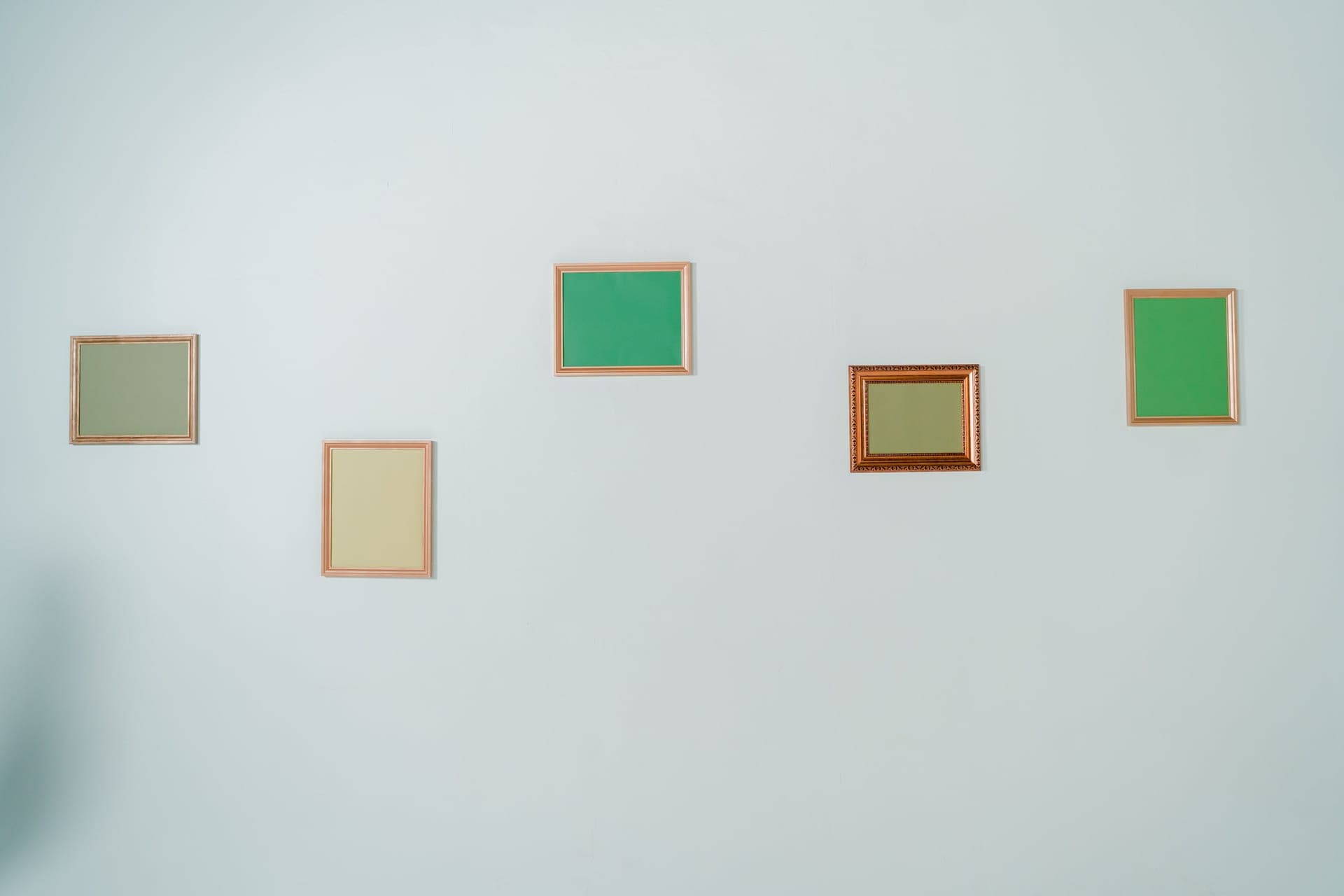
Work from the wall, not from the frames. Cover roughly two thirds to three quarters of the usable wall width, keep 2 to 3 inches between frames, and divide the result by your frame width plus one gap. For a 60-inch wall above a sofa that is typically five frames at 11x14, or three at 16x20.
Odd counts — three, five, seven — are easier to arrange than even ones, because an odd group has a natural center to balance around and an even group does not.
Disclosure: Hang & Hue earns commission from qualifying purchases made through the links on this page, at no extra cost to you. As an Amazon Associate we earn from qualifying purchases. It does not change which products we recommend or the order they appear in — read our editorial policy and full affiliate disclosure.
Quick picks
Tap any row to jump to the full write-up.
| # | Product | Best for | Price |
|---|---|---|---|
| 1 | 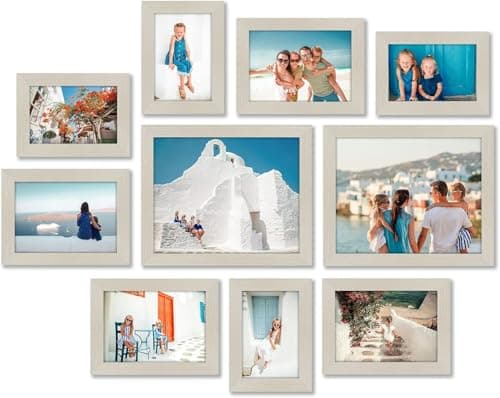 Americanflat Gallery Wall Frame Set Mixed-size sets designed to hang as one arrangement, with hanging hardware and, on some sets, a layout template. The template is the part that answers this question before you measure anything. | Best for deciding the count for you | $38.99 · View on Amazon #ad How we’re funded · Price as of November 1, 2026 |
| 2 | 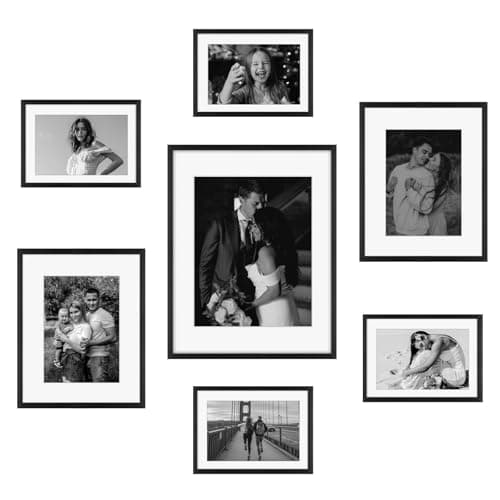 Frametory Aluminum Gallery Wall Frame Set, Black Seven matched aluminum frames — one 11x14, two 8x10 and four 5x7 — with removable mats. A ready-made answer for a wide wall that needs an anchor plus satellites. | Best seven-frame set | $48.99 · View on Amazon #ad How we’re funded · Price as of November 1, 2026 |
| 3 | 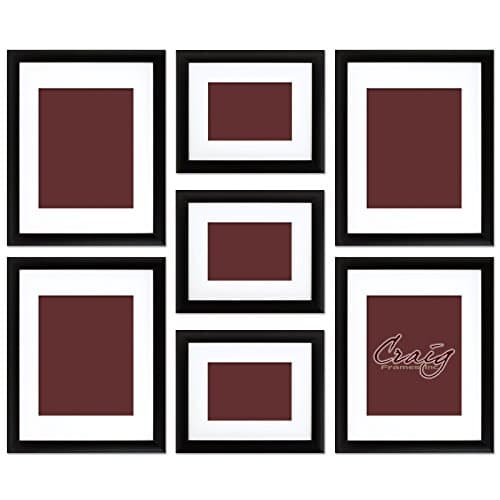 Craig Frames Matted Gallery Set Sets of four in one size, matted down to a smaller opening, with lightweight acrylic glazing. Four in a two-by-two grid is the even count that works, because the grid supplies the order. | Best four-frame set | $64.99 · View on Amazon #ad How we’re funded · Price as of November 1, 2026 |
| 4 | 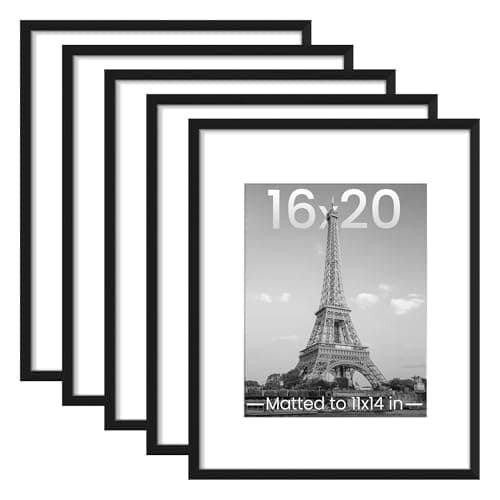 upsimples Gallery Wall Frame Set Matched multi-packs in one repeated size with mats and hardware included. One size repeated is what a grid needs, and buying it as a pack keeps the finishes identical. | Best for a strict grid | $46.99 · View on Amazon #ad How we’re funded · Price as of November 1, 2026 |
How much of the wall a gallery should cover
The arrangement should read as one object filling most of the available space, not as several small objects scattered in a large one. The working figure is two thirds to three quarters of the usable width — usable meaning the wall minus any furniture, door casings or switches at the edges.
Where the arrangement sits above furniture, the furniture sets the width instead: the group should span about two thirds to three quarters of the sofa, console or bed below it. Narrower than that and the wall looks empty; wider and the furniture looks undersized. Art above the couch and art above the bed apply the rule to the two most common cases.
Frame count by wall width
The table below assumes a single row, 2.5 inches between frames, and a target coverage of about 70% of the wall width. Add a second row and the counts double; the width arithmetic does not change.
| Usable wall width | Target span (~70%) | At 8x10 | At 11x14 | At 16x20 |
|---|---|---|---|---|
| 36 in | 25 in | 3 frames in a row | 2 frames | 1 frame |
| 48 in | 34 in | 3 frames | 3 frames | 2 frames |
| 60 in | 42 in | 4 frames | 3 frames | 2 frames |
| 72 in | 50 in | 5 frames | 4 frames | 3 frames |
| 96 in | 67 in | 6 frames | 5 frames | 3 frames |
| 120 in | 84 in | 8 frames | 6 frames | 4 frames |
Two notes on reading it. Frames hung landscape rather than portrait use more width each, so the counts drop. And a two-row arrangement does not need to be twice as wide — it needs the same width and twice the height, which is why a tall narrow wall takes a stacked layout rather than a longer row.
Why odd numbers are easier
Three, five and seven frames each have a middle. That middle gives you something to center on the wall or on the furniture below, and everything else balances outward from it. Four and six frames have a gap in the middle instead, which means the arrangement is centered on empty space.
That is not a prohibition. Even counts work extremely well in a strict grid — two by two, two by three, three by three — because the grid itself supplies the order the odd number would have supplied. The rule in practice is: odd numbers for loose arrangements, any number for a grid. Grid versus salon style covers which one suits which wall.
The spacing that decides whether it reads as one group
2 to 3 inches between frames, consistently, for frames up to about 16x20. Larger frames can take 3 to 4. What matters more than the exact figure is that it does not vary: inconsistent gaps are what make an arrangement look accidental, and the eye detects them at a glance even when it cannot say why.
Keep the gap smaller than the smallest frame's short dimension, always. A 5x7 frame with 6 inches of space around it has stopped being part of the group. Gallery wall layouts and spacing has the full method, and gallery wall templates has to-scale diagrams for three, five, seven and nine frames.
When the answer is fewer than you think
Three reasons to reduce the count. Every frame is a fixing, a measurement and a chance to hang something crooked, and nine of those is a long evening. Every frame is also a cost multiplier — what a gallery wall costs works through that. And a wall of many small frames reads as busy in a room that is already busy.
The limiting case is one piece. A single large print or canvas covers the same area, costs less than a multi-frame arrangement, and goes up in twenty minutes — gallery wall versus one large piece makes both arguments honestly.
In a small room, fewer and larger is almost always the better call; small apartment gallery walls covers that case specifically.
Confirming the count before you commit
Cut paper rectangles at each frame's outer size, tape them to the wall in the arrangement you intend, and leave them for a day. This costs nothing, takes fifteen minutes, and is the only reliable way to find out that seven frames is two too many.
If you are hanging without drilling, confirm the weight per frame at the same time. 3M rates Command Large Picture Hanging Strips at 4 lb per set and up to 16 lb per frame using four pairs, and a nine-frame wall needs that count worked out in advance — hanging a gallery wall without nails has the per-frame method.
The picks in full
Each entry states what it is for, the specification that decides it, and who should skip it.
1. Best for deciding the count for you
Americanflat Gallery Wall Frame Set
Americanflat
Mixed-size sets designed to hang as one arrangement, with hanging hardware and, on some sets, a layout template. The template is the part that answers this question before you measure anything.
- Set shape
- Mixed-size sets designed to hang as one arrangement
- Glazing
- Shatter-resistant plexiglass
- Matting
- Mats included on most sizes in the set
- Included
- Hanging hardware and, on some sets, a layout template
The spec that decides it: Mixed-size sets designed as one arrangement; hardware and, on some sets, a layout template.
Skip it if: You already know your layout and want one repeated size.
#ad How we’re funded · Price as of November 1, 2026
2. Best seven-frame set
Frametory Aluminum Gallery Wall Frame Set, Black
Frametory
Seven matched aluminum frames — one 11x14, two 8x10 and four 5x7 — with removable mats. A ready-made answer for a wide wall that needs an anchor plus satellites.
- Contents
- 7 frames - one 11x14, two 8x10, four 5x7
- Molding
- Aluminum, matched across the whole set
- Glazing
- Glass fronts
- Matting
- Removable mats and built-in hangers included
The spec that decides it: 7 frames: one 11x14, two 8x10, four 5x7; matched aluminum molding; removable mats.
Skip it if: Your wall is under about 60 inches wide — seven frames will overfill it.
#ad How we’re funded · Price as of November 1, 2026
3. Best four-frame set
Craig Frames Matted Gallery Set
Craig Frames
Sets of four in one size, matted down to a smaller opening, with lightweight acrylic glazing. Four in a two-by-two grid is the even count that works, because the grid supplies the order.
- Set shape
- Sets of four in one size, matted down to a smaller opening
- Glazing
- Lightweight shatter-resistant acrylic
- Profiles
- Contemporary through ornate
- Origin
- Made in the USA
The spec that decides it: Sets of four in one size, matted to a smaller opening; shatter-resistant acrylic.
Skip it if: You want a loose arrangement — an odd count is easier to balance.
#ad How we’re funded · Price as of November 1, 2026
4. Best for a strict grid
upsimples Gallery Wall Frame Set
upsimples
Matched multi-packs in one repeated size with mats and hardware included. One size repeated is what a grid needs, and buying it as a pack keeps the finishes identical.
- Set shape
- Matched multi-packs, usually one repeated size
- Glazing
- High-definition plexiglass
- Matting
- Mat included on most sizes
- Included
- Wall-mount hardware
The spec that decides it: Matched multi-packs, one repeated size, mat and wall-mount hardware included.
Skip it if: Your arrangement needs an anchor piece — a mixed-size set handles that better.
#ad How we’re funded · Price as of November 1, 2026
Common questions
How many frames should a gallery wall have?
Work it out from the wall rather than choosing a number. Cover about two thirds to three quarters of the usable wall width, allow 2 to 3 inches between frames, and divide. A 60-inch wall typically takes five 8x10 frames, three or four at 11x14, or two at 16x20 in a single row.
How much of a wall should a gallery wall cover?
Roughly two thirds to three quarters of the usable width. Where the arrangement sits above furniture, the furniture sets the span instead — aim for two thirds to three quarters of the sofa, console or bed below it. Less than that and the wall reads as empty; more and the furniture looks undersized.
Should a gallery wall have an odd or even number of frames?
Odd numbers are easier for loose arrangements, because three, five or seven frames have a natural middle to center on the wall or the furniture below. Even numbers work well in a strict grid — two by two, two by three, three by three — because the grid supplies the order that the odd number would otherwise provide.
How far apart should gallery wall frames be?
2 to 3 inches for frames up to about 16x20, and 3 to 4 inches for larger ones. Consistency matters more than the exact figure: varying gaps are what make an arrangement look accidental. Keep the gap smaller than the shortest dimension of the smallest frame in the group.
Is it better to have fewer, larger frames?
Usually, in a small room or on a tight budget. Fewer frames means fewer fixings, fewer measurements, fewer chances to hang something crooked, and a lower total cost, because frame count multiplies every other line item. Many small frames suit a large wall in an otherwise plain room.
Sources for the figures on this page
Read next
- Gallery Wall Layouts and Spacing
The 2-3 inch gap rule, the 57 inch group center, and how to size the whole arrangement to the furniture below it.
- Gallery Wall Templates
To-scale layouts for 3, 5, 6, 7 and 9 frames with all dimensions labeled — the page no competitor publishes.
- Grid vs Salon-Style
Grid or salon-style: difficulty, forgiveness, which rooms each suits, and how each one behaves when you add a frame later.
- How Much Does a Gallery Wall Cost?
Frame count, frame size, glazing and art: the four multipliers behind a gallery wall budget, and where each dollar actually goes.
- Gallery Wall vs One Large Piece
Gallery wall or one big artwork, compared on cost, fixing count, how forgiving each is to hang, and what each does to a small room.
- Frame Sizes for Gallery Walls
Frame size combinations by target wall width, with gaps included — the arithmetic to do before ordering.
- How High to Hang Art
The 57-inch gallery standard, the hook-position arithmetic, and the exceptions for sofas, beds, dining rooms and stairs.